7.62x25mm Tokarev: The Speed Demon of Soviet Sidearms – A Legacy and Performance Review

Updated: Aug 10, 2025

Introduction
The 7.62x25mm Tokarev, also known as the .30 Tokarev, is a cartridge with a legacy carved into the steel and grit of 20th-century warfare. Developed from the 7.63x25mm Mauser, this high-velocity pistol round powered numerous Soviet sidearms and submachine guns, leaving an indelible mark on military history. While no longer standard issue, the 7.62x25mm still intrigues enthusiasts for its punchy performance and historical significance.
Origins and Development
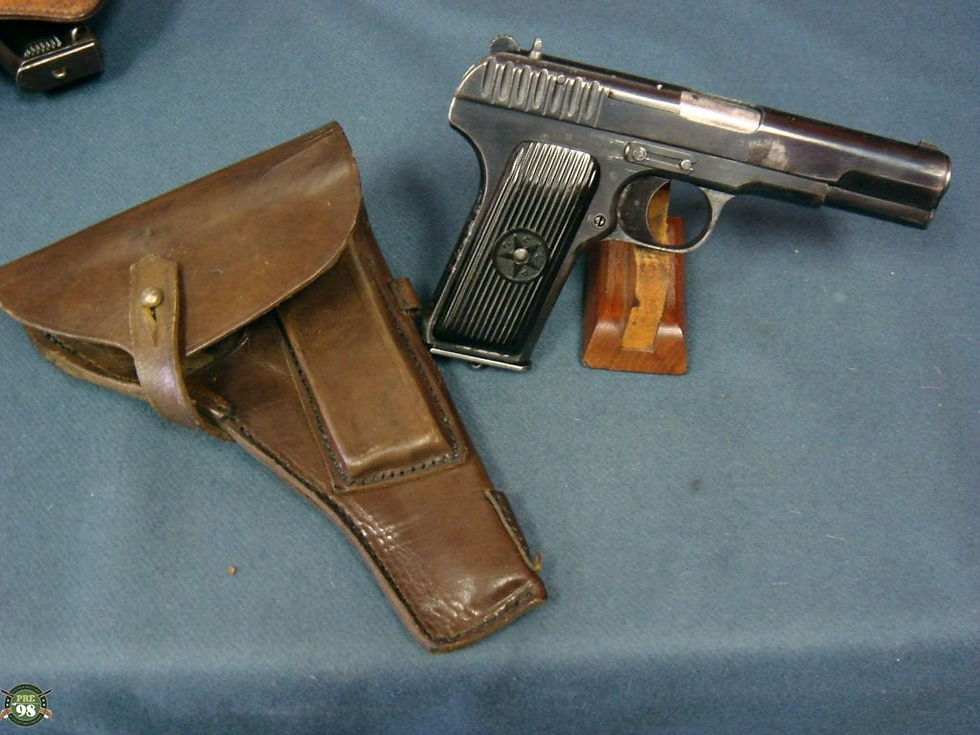
The 7.62x25mm cartridge was adopted by the Soviet Union in the early 1930s, evolving from the German 7.63x25mm Mauser used in the iconic C96 "Broomhandle" pistol. The Soviets, under the guidance of Fedor Tokarev, strengthened the case walls and increased the powder charge to suit their new pistol: the TT-30, and later, the more widely issued TT-33.
Unlike many pistol rounds of its era, the 7.62x25 was designed for both pistols and submachine guns, particularly the PPSh-41 and PPS-43, providing a common cartridge that could serve across infantry ranks.
Ballistic Performance
The standout feature of the 7.62x25mm is velocity. With muzzle speeds in the range of 1,400 to 1,600 fps (depending on the load), it significantly outpaces most contemporary pistol rounds, including the 9mm Parabellum. Typical bullet weight ranges from 85 to 90 grains, with energy levels around 500 ft-lbs, making it ideal for penetrating body armor of its time.
Key performance traits:
High velocity and flat trajectory – accurate at extended pistol ranges
Excellent penetration – capable of defeating WWII-era helmets and light armor
Recoil – snappy, but manageable due to Tokarev’s slim grip and ergonomics
Overpenetration – a known issue, especially in urban or civilian contexts
Historical Use and Impact
The 7.62x25 saw extensive action during World War II, with Soviet troops wielding PPSh submachine guns in brutal close-quarters combat. Its effectiveness in urban warfare was unmatched — fast-firing guns like the PPSh-41 could suppress and eliminate threats with authority, thanks largely to the cartridge's performance.
Beyond the USSR, many Warsaw Pact nations and allies used the round, with local variants of the TT-33 and other designs emerging in China, Hungary, Romania, and Yugoslavia.
Post-WWII, the cartridge began to fade from military use, replaced by the more modern and subsonic 9x18mm Makarov in Soviet service. However, the Tokarev round maintained popularity among surplus collectors and Cold War-era stockpiles for decades.
Modern-Day Appeal
While not widely adopted today for tactical use, the 7.62x25mm Tokarev remains a favorite among:
Military surplus collectors
Ballistic experimenters
Vintage pistol and SMG enthusiasts
Reloaders seeking performance
Legacy and Cultural Footprint
The 7.62x25 is more than just a fast cartridge — it's a symbol of Soviet engineering and wartime necessity. It powered the Red Army through pivotal battles and became synonymous with raw, utilitarian firepower. Its sonic crack and blistering speed turned humble pistols and compact SMGs into formidable tools of war.
The 7.62x25mm Tokarev might be a relic of the past, but it’s far from forgotten. Its performance still holds up, and its history is deeply embedded in the story of 20th-century conflict. Whether you're a collector, a shooter, or a history buff, this cartridge deserves respect not just for its ballistics, but for its battlefield legacy.
Fast, loud, and deadly — the 7.62x25mm is the Cold War’s smoking gun.
.30 Tokarev vs .45 ACP – Side-by-Side Comparison
Feature | 7.62x25mm Tokarev (.30) | .45 ACP |
Bullet Diameter | 7.62 mm (0.30 in) | 11.43 mm (0.45 in) |
Typical Bullet Weight | 85–90 grains | 185–230 grains |
Muzzle Velocity | 1350–1600 fps (high) | 830–950 fps (subsonic) |
Muzzle Energy | 678–746 joules | 475–678 joules |
Penetration | Excellent (can pierce helmets & barriers) | Moderate (good against soft targets) |
Recoil | Mild to moderate (sharp kick) | Heavy, slow push |
Effective Range | ~100–150 meters (in SMGs) | ~50 meters (in pistols) |
Stopping Power | Moderate – depends on penetration | High – large wound channel |
Use in SMGs | Yes (e.g., PPSh-41, PPS-43) | Rare (mainly pistols only) |
Ammo Size | Long, bottleneck cartridge | Short, fat straight-wall cartridge |
Armor Penetration | High – excellent against light armor | Low – not armor-piercing |

Design Philosophy Differences
Cartridge | Design Intent |
7.62x25mm Tokarev  | Built for velocity, penetration, and range – ideal for submachine guns and high-speed pistols. |
.45 ACP  | Designed for stopping power and knockdown – ideal for close-quarters combat. |
Practical Performance Comparison
1. Ballistics
Tokarev flies flatter, hits faster, and penetrates deeper — capable of piercing WWII helmets and soft body armor.
.45 ACP delivers a bigger, slower bullet that causes more damage to soft tissue but lacks penetration.
2. Terminal Ballistics
Tokarev may over-penetrate, especially with FMJ — less energy transfer to the target.
.45 ACP (especially JHPs) dump energy quickly, causing more incapacitation per shot.
3. Magazine Capacity
Because .45 ACP is larger, pistols like the 1911 often carry 7-8 rounds.
Tokarev pistols carry 8–9 rounds, and SMGs like the PPSh-41 can hold 35–71 rounds.
When to Choose Which?
If you want... | Choose... |
High speed, flat shooting, armor-piercing | 7.62x25 Tokarev |
Maximum stopping power at close range | .45 ACP |
Collectibility, Soviet/Warsaw Pact history | .30 Tokarev |
Big-bore American classics and power | .45 ACP |
Final Verdict
7.62x25 Tokarev is a speed demon, great for range and penetration, especially in SMG or carbine use.
.45 ACP is a heavy hitter, optimized for close-quarters combat with proven stopping power.
Both are legendary — one is a high-velocity needle, the other a slow-moving hammer.


Comments