Firearm Sale, Transfer & Deposit Rules in IndiaComplete Guide under the Arms Act, 1959 & Arms Rules, 2016

Updated: Feb 15
Owning a firearm in India comes with significant legal responsibility. Whether you’re selling your weapon to another licence holder, transferring it to a dealer, or depositing it temporarily during elections, every step is governed by precise procedures under the Arms Act, 1959, and Arms Rules, 2016.
1. Legal Foundation
The regulation of firearm transfers in India originates from:
Section 5 of the Arms Act, 1959 — governing the sale and transfer of arms and ammunition.
Rules 47, 48, 75, and 76 of the Arms Rules, 2016 — detailing procedures for transfer and deposit.
2. Understanding Section 5(2)(b): The 45-Day Waiting Period
The most critical provision for private sellers is found in Section 5(2)(b) of the Arms Act, 1959, which states:
“No firearm or ammunition in respect of which a licence is required under section 3 shall be so sold or transferred by any person unless—(a) he has informed in writing the District Magistrate having jurisdiction or the officer-in-charge of the nearest police station of his intention to sell or transfer … and the name and address of the person to whom he intends to sell or transfer; and(b) a period of not less than forty-five days has expired after the giving of such information.”
What this means:
Before selling or transferring your licensed firearm, you must notify your local District Magistrate (DM) or police station in writing.
You must then wait 45 days from the date of that intimation before completing the sale or transfer.
The rule applies to all transfers — including those to another private licence holder and to a licensed dealer, unless the DM grants written permission sooner.
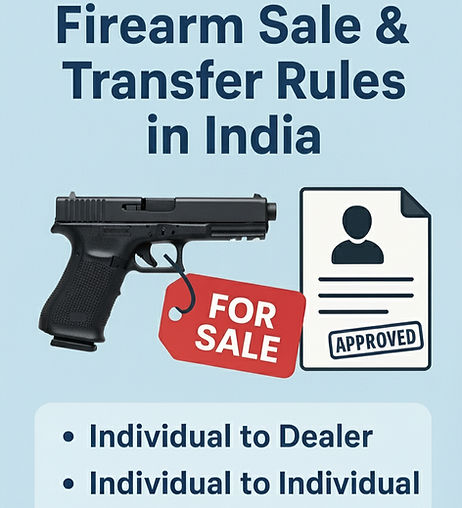
3. Case 1 — Individual → Individual Transfer
Relevant law: Section 5(2)(b), Arms Act 1959; Rule 46(1)(b), Arms Rules 2016.
Procedure:
Inform the licensing authority (DM or O/C Police) in writing using the prescribed format (Form VII).
Wait 45 days for approval or objection.
If no objection is raised, the transfer is deemed approved.
Buyer must endorse the weapon on their licence after purchase.
4. Case 2 — Individual → Dealer Sale or Deposit
Relevant law: Section 5(2)(b), Arms Act 1959; Rule 75 of Arms Rules 2016.
The dealer can receive the weapon after the 45-day intimation period or if the DM provides written NOC/approval earlier.
The dealer must then record full transaction details.
In India, there is no mandatory waiting period to resell a firearm after purchase, but the legal process for selling a firearm must still be followed, which involves a minimum 45-day notice period to the authorities. However, frequent resale of newly acquired weapons may raise suspicion with the licensing authority, which can question the owner's "good reason" for possessing firearms.
5. Deposit of Firearms with a Licensed Dealer under Indian Law
Under Indian law, Rule 48 of the Arms Rules, 2016, governs how licensed firearm owners can deposit their weapons for safe custody. This often comes into play during elections, license renewals, or temporary suspensions of firearm possession — they must deposit the weapon either:
With the officer-in-charge of the nearest police station,
With a licensed firearms dealer, or
For armed forces personnel, in the unit armoury.
When a firearm is deposited, the owner receives a receipt and retains legal ownership. The firearm can later be reclaimed or sold to an eligible person within the allowed period. If not reclaimed or disposed of in time, it becomes forfeited to the government.
Deposit of Firearms During Elections
During elections, district authorities often order all licence holders to deposit their firearms temporarily for security reasons. This is governed by Rule 48 of the Arms Rules 2016, which provides:
“A person lawfully possessing arms or ammunition may deposit them for safe custody with a dealer holding a licence in Form VIII or in a police station or, if he is a member of the armed forces of the Union, in a unit armoury.”
⚖️Judicial oversight and recent rulings
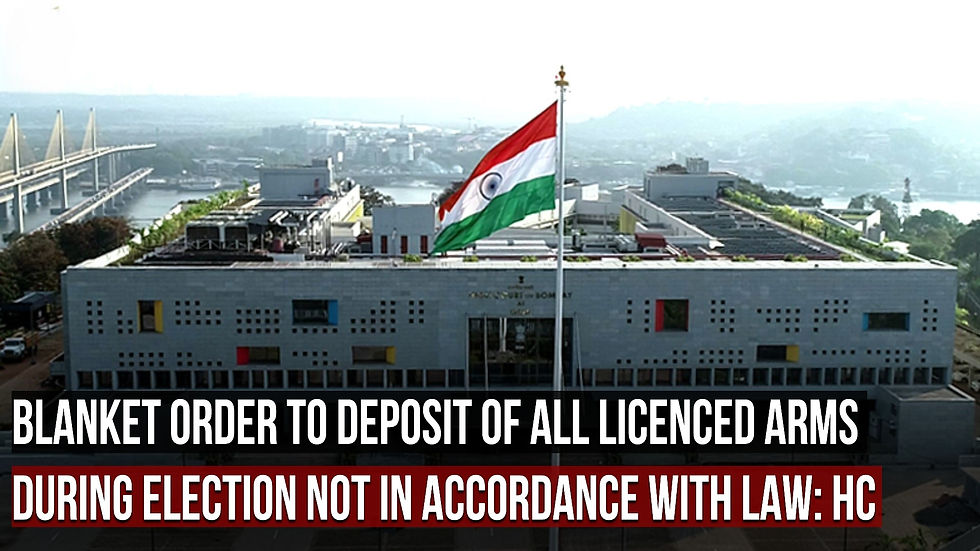
The practice of issuing blanket orders for depositing firearms has been successfully challenged in the High Courts.
Karnataka High Court: In May 2024, the Karnataka High Court ruled against blanket orders, emphasizing that a targeted approach based on individual risk assessment is necessary.
Punjab and Haryana High Court: In May 2024, the Punjab and Haryana High Court also issued a similar ruling, stating that there should not be a "blanket direction to surrender arms" without a proper review.
Summary: Correct vs. Incorrect procedure
Aspect | Incorrect or Outdated Approach | Correct, Legally Compliant Procedure |
Deposit Order | Blanket order for all license holders. | Targeted order based on risk assessment by a Screening Committee. |
Timing | Immediate deposit upon election announcement. | Deposit only after receiving a specific notice following the screening committee's decision. |
Basis | General security concerns. | Individual risk assessment and history of criminal offences. |
Legal Backing | Outdated practice, often challenged. | Mandated by the Election Commission and upheld by recent court rulings. |
In short, while firearms are deposited during elections, it is no longer a blanket requirement but a targeted process managed by screening committees under the strict directives of the Election Commission of India.


Suraj